From Bad Breath to Vet Bills: A Practical Guide to Dog Dental Health
If you have ever dealt with your own dental problems, you already understand the core truth. Dental care is not cosmetic. It is health care.

The same is true for dogs.
A dog's mouth is a gateway to the rest of the body. When the mouth is healthy, eating is comfortable, breath is normal, and the gums look calm and pink.
When dental hygiene declines , plaque and bacteria build up. Gums can become irritated. Teeth can weaken. And what started as "a bit of bad breath" can slowly turn into problems that require professional treatment.
That is why dental care should be seen as an integral part of a dog's overall health – just like it is for humans. It is not something you only do when there is already a visible problem. Prevention is easier, cheaper, and kinder for your dog.
Why dental health matters (and what happens if you ignore it)
Dental problems usually begin with plaque. Plaque is a soft film made of bacteria and food residues. It forms every day. If it is not managed, it can harden into tartar, irritate the gums, and create a mouth environment where "bad" bacteria thrive.
Here are the common issues dog owners see—and the consequences behind them:
Plaque buildup along the gumline

If plaque stays, it feeds bacteria and keeps the gumline inflamed. Over time, this increases the risk of gum disease and discomfort while eating.
Tartar (hard deposits) forming on the teeth

Once plaque mineralizes into tartar, it is difficult to remove at home. Tartar creates rough surfaces that collect even more plaque, accelerating the cycle.
Red, sensitive, or bleeding gums
Gum irritation can progress to periodontal disease. That can mean pain, reluctance to chew, and in advanced cases, loosening teeth.
Persistent bad breath

Bad breath is often a sign of bacterial imbalance and buildup in the mouth. It is not just unpleasant—it can be a signal that oral health is declining.
Difficulty chewing or changes in eating behavior
Dogs may chew on one side, drop kibble, avoid harder foods, or eat more slowly. Owners sometimes interpret this as fussiness, but discomfort is a common cause.
More dental cleanings and more expensive vet visits

When tartar and gum disease progress, professional cleaning becomes more likely. In severe cases, extractions may be needed. Dental procedures can be costly, and the earlier you start prevention, the more you reduce the odds of getting to that stage.
Overall, poor dental care can lead to a long-term cycle: more buildup, more inflammation, more bacterial load, and higher likelihood of veterinary dental treatment. Supporting dental health early is one of the simplest ways to reduce preventable problems later.
Important: If you see swelling, bleeding, obvious pain, or your dog is refusing food, speak to your veterinarian. Those are not "wait and see" signs.
Should dental care be "default mode" for every dog?
For most dogs, yes. Plaque forms daily, even in dogs that eat well and seem fine.
Dental support should be routine, not reactive. This is especially true for:
- Small breeds (often more prone to plaque and tartar)
- Senior dogs
- Dogs eating mostly wet food
- Dogs that do not chew much or do not chew effectively
- Dogs with ongoing breath issues
In other words, you do not need to "wait for a problem" to justify dental care. If your dog has teeth, it is worth supporting them.
Early signals: what to watch for

You do not need to become a dental expert. But you should know the common early signals:
- Persistent bad breath
- Visible yellow or brown deposits (often on the back molars first)
- Redness along the gumline
- Chewing changes (avoiding hard items, dropping kibble, chewing on one side)
- Increased drooling or pawing at the mouth
If you see one of these, it is a good time to start a consistent routine. If you see several, it is worth taking a closer look—and possibly getting a vet dental check.
The 4 pillars of practical daily dental support
1) Reducing plaque (the daily starting point)

Plaque forms every day. That is why plaque management is the foundation of dental care.
When plaque is kept lower:
- the gumline is less irritated
- the mouth environment stays more balanced
- there is less "starting material" for tartar
Goal: reduce the daily buildup so it does not snowball.
2) Preventing tartar mineralization (stopping "soft" from becoming "hard")

Tartar is what happens when plaque hardens through mineralization. Once that happens, home care becomes much harder.
Prevention matters because:
- tartar sticks strongly to teeth
- tartar surfaces help more plaque adhere
- the cycle speeds up over time
Goal: support the mouth so fewer minerals bind and hard deposits form more slowly.
3) Supporting the oral microbiome (because balance drives outcomes)

A dog's mouth contains many microbes. Some are neutral. Some are helpful. Some contribute to odor and irritation when they dominate.
Supporting the oral microbiome aims to:
- promote a healthier microbial balance
- reduce odor-producing bacterial activity
- support healthier gums over time
Goal: a mouth that stays stable rather than swinging into chronic "bad breath + irritation."
4) Breath freshening (what owners notice first, and why it matters)

Breath is often the first signal owners detect. Breath support is not just about scent. It is often about improving the mouth environment that causes the odor.
Good breath support should:
- help reduce the compounds that drive odor
- support daily cleanliness so the odor returns less quickly
Goal: fresher breath that reflects better oral conditions, not just masking.
Is this something you should do every day?
Yes. For most dogs, daily is ideal.
Plaque forms daily. So the most effective routines are daily routines.
This does not need to be complicated. The key is consistency. A simple habit you can repeat is usually better than an "ideal" routine you cannot maintain.
What can you do to help your dog?
There are several ways to support dog dental health. Many owners use a mix.
Brushing
Brushing is a strong option when it is realistic.
- Best for: dogs that tolerate it and owners who can do it consistently
- Challenge: many dogs resist it, and many routines fade over time
Dental chews and treats
Chews can help, but results vary.
- Best for: dogs that chew effectively and consistently
- Challenge: not every dog chews long enough, and calories can add up
Professional cleaning
This is important when tartar is already heavy.
- Best for: advanced buildup and gum disease
- Challenge: not a prevention plan by itself—daily care still matters afterward
Food toppers (powder supplements)
Toppers that you mix with your dog's food are often the most realistic "daily baseline."
- Best for: owners who want consistency without stress
- Why they work: they fit every meal, every day, with minimal effort
A topper is not meant to replace veterinary care when disease is advanced. But as part of prevention, it is one of the easiest routines to maintain.
dentQR: daily dental support that fits real life

dentQR is a once-daily powder topper designed around the pillars of practical dental support: plaque control, tartar prevention support, microbiome support, and breath freshening.
What dentQR is designed to help with
- Plaque support as part of a daily routine
- Tartar mineralization support with targeted ingredients
- Oral microbiome support using probiotic + postbiotic components
- Breath support with herbs and a cleaner-mouth approach
What's inside?
dentQR includes:
- SHMP (sodium hexametaphosphate) to support tartar prevention by helping bind minerals
- Ascophyllum nodosum (seaweed) , a well-known dental-support ingredient
- Enterococcus faecium (probiotic) + HA-122 (postbiotic) to support a balanced microbiome
- Chelated zinc for high bioavailability
- Cranberry, pomegranate, blueberry as plant-polyphenol sources
- Peppermint + parsley for breath support
- FOS (prebiotic) to support beneficial bacteria
How to use
Mix the daily serving in your dog's food once per day or split into two meals. Consistency matters most.
If you want dental care to become "default mode" without daily brushing battles, dentQR is designed to be the easy routine you can stick to.
-
Belly Biotics Welcome UK
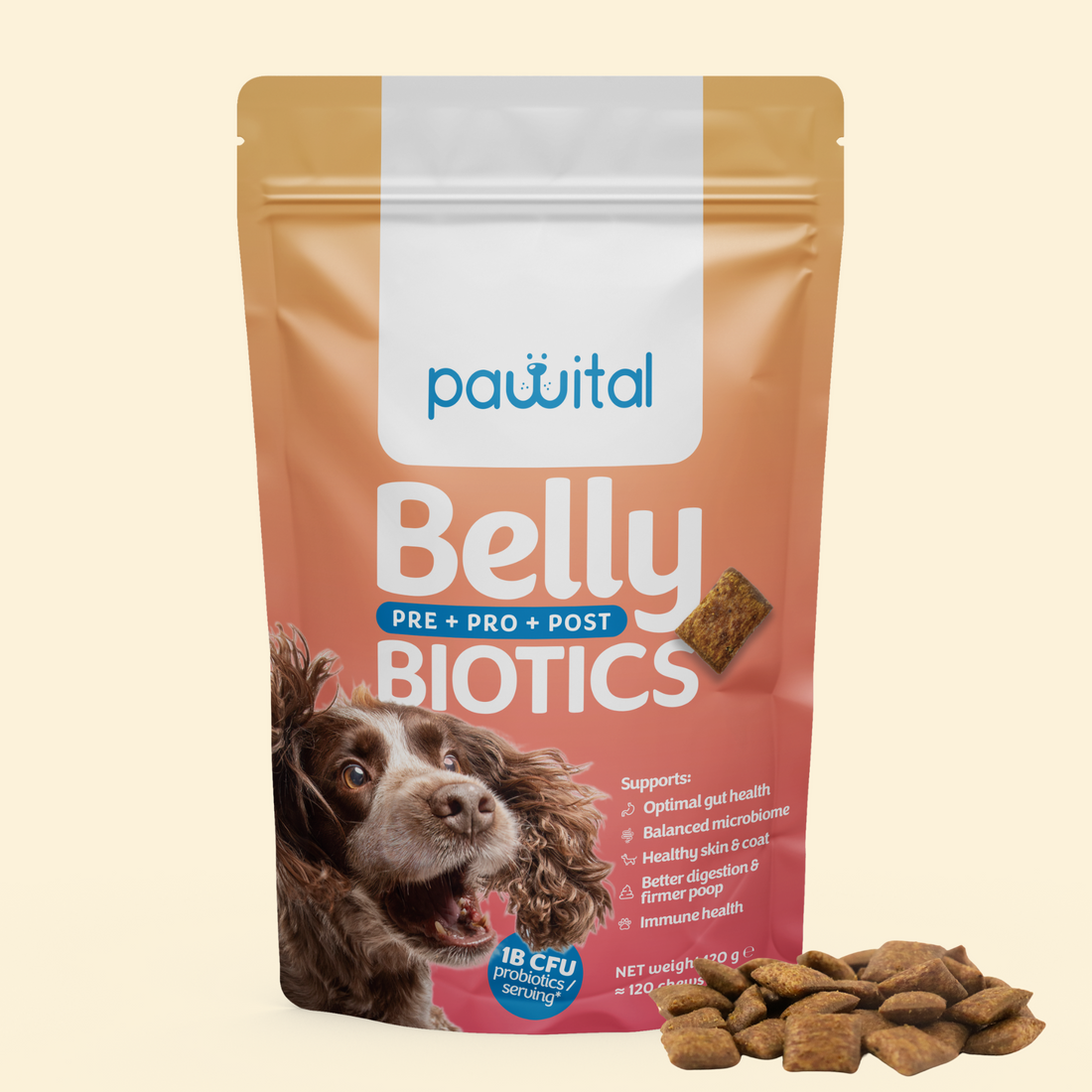 Belly Biotics Welcome UK
- Regular price
-
£19.90 £59.90 - Regular price
-
£19.90 - Sale price
-
£19.90 £59.90
-
Belly Biotics (360 treats UK)Belly Biotics (360 treats UK)
- Regular price
-
From
£29.90 - Regular price
-
£59.70 - Sale price
-
From
£29.90